
BPMKeyFinder
BPMKeyFinder - Analyze Song BPM & Key Locally
Introduction:
Browser-based tool detecting BPM and musical key locally using Essentia.js. Instant tempo and harmonic analysis for DJs and producers.
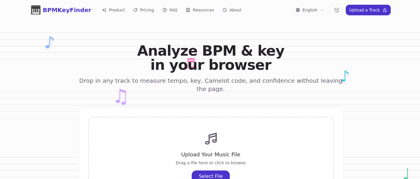
BPMKeyFinder Product Information
What is BPMKeyFinder ?
BPMKeyFinder is a privacy-first web application that analyzes audio files locally in the browser to detect BPM (tempo) and musical key. Powered by Essentia.js from the Music Technology Group, the tool provides field-tested accuracy for DJs, music producers, and educators. It supports multiple audio formats (MP3, WAV, FLAC, AIFF, AAC, OGG) and displays results with Camelot wheel codes for harmonic mixing. All processing occurs client-side without uploads, ensuring complete privacy for unreleased tracks. The tool includes confidence scoring, batch processing capabilities, and CSV export options for professional workflows.
BPMKeyFinder's Core Features
Local browser-based processing with Essentia.js - no uploads required
Automatic BPM detection with normalization to 60-180 range
Musical key identification in standard notation and Camelot codes
Confidence score indicators for detection reliability
Support for multiple audio formats (MP3, WAV, FLAC, AIFF, AAC, OGG)
Batch processing capability for multiple tracks (Pro)
CSV export and analysis history (Pro)
Mobile-responsive interface for on-the-go analysis
Major/minor mode detection
No internet connection required after initial page load
Raw tempo estimates available for advanced users
Metadata syncing capabilities (Pro)
Priority email support (Pro)
BPMKeyFinder's Use Cases
#1
Verifying tempo and key compatibility before DJ sets and live performances
#2
Planning harmonic transitions using Camelot wheel for seamless mixing
#3
Organizing music libraries with accurate BPM and key metadata
#4
Analyzing promo tracks and unreleased music with complete privacy
#5
Aligning samples and stems to project grids in music production
#6
Determining if vocal or instrument tracks need transposition or time-stretching
#7
Planning choreography with precise tempo information for dance classes
#8
Creating CSV reports for syncing with DJ software like rekordbox or Engine DJ
#9
Teaching music theory and song structure analysis in educational settings
#10
Batch analyzing multiple tracks for efficient library management
BPMKeyFinder's Pricing
Free - $0/month - 3 analyses per day, single-file uploads, core BPM and key detection, in-browser processing
Pro - $8/month - Unlimited analyses, batch uploads, CSV export, analysis history, metadata syncing, priority email support
FAQ from BPMKeyFinder
What audio formats does BPM Key Finder support?
- BPMKeyFinder supports most common audio formats including MP3, WAV, FLAC, AIFF, AAC, OGG, and other standard audio file types. Extended mixes are also supported depending on device memory capacity.
Is my audio file uploaded to a server?
- No, BPMKeyFinder processes all files locally in the browser using Essentia.js. Audio files never leave the device, ensuring complete privacy and security with no cloud processing involved.
How accurate is the BPM and key detection?
- BPMKeyFinder uses Essentia.js, the WebAssembly build of Music Technology Group's MIR toolkit, providing field-tested accuracy. The tool cross-checks tempo estimates and normalizes BPM to the practical 60-180 range while including confidence scores for each detection.
Is there a file size limit?
- There is no strict file size limit. Most computers can comfortably analyze tracks over 20 minutes long, though processing time depends on device memory and browser performance.
Do I need to create an account to use BPM Key Finder?
- No account is required for the free tier, which allows 3 analyses per day with single-file uploads. The Pro plan ($8/month) offers unlimited analyses, batch processing, CSV export, and analysis history.
What is the Camelot code feature?
- BPMKeyFinder displays musical keys in both standard notation (e.g., C major, A minor) and Camelot wheel codes (e.g., 8B, 9A), making it easier to identify harmonically compatible tracks for seamless mixing.